 Michael Turner
 Key Takeaways
- OP means the freezer temperature sensor circuit is open and SH means it is shorted, so the board cannot read the cabinet temperature.
- Without sensor feedback the compressor runs on a default schedule, so the cabinet can run warmer or colder than the set point.
- Neither code can be cleared by a power reset, because the fault is physical: a broken wire, a failed probe or a bad connector.
- Check the real temperature with a separate thermometer before trusting the display or keeping food in the freezer.
- HI, dF and PF are different faults, and a sensor fault can occur while the refrigeration itself is working.
The Bottom Line
If the display shows OP or SH, put a thermometer in the cabinet and read the real temperature. Short-term use is acceptable only while it stays in a safe range, and a technician should test the sensor and connector.
Most freezer trouble announces itself with warm food. A faulty sensor does something stranger: the freezer carries on running, but the control board has lost its thermometer and is guessing. On the electronic upright freezers this site covers, that shows up as OP or SH on the display in place of the temperature, and the cabinet may run colder or warmer than the set point depending on the day. This guide is about that fault, the Kenmore upright freezer temperature sensor circuit, and how it differs from the defrost, high-temperature and no-cooling faults already covered elsewhere on the site.
| Display | What the site says it reports | What the cabinet does | Does a reset clear it? |
|---|---|---|---|
| OP | Temperature sensor open circuit | Runs on a default schedule, can be warmer or colder than set | No, the circuit is physically open |
| SH | Temperature sensor short circuit | Tends to over-run and get colder than needed | No, it is a live circuit fault |
| HI | High temperature alarm, not a mechanical fault | Already above safe storage temperature | The alarm button silences it, the cause remains |
| PF | Power failure notification | Normal once power is back | Yes, with the alarm reset |
What Do OP and SH Mean on a Kenmore Upright Freezer?
OP means the temperature sensor circuit is open and SH means it is shorted, so in both cases the board cannot read a valid temperature. The site describes them as mirror faults on the Kenmore Elite 253-series upright freezers. The sensor is a thermistor, a small probe whose electrical resistance changes with temperature, and the board needs a sensible resistance reading to decide when to run the compressor.
Our pages for freezer OP and freezer SH give the causes in the same three groups, which is useful because only one of them needs a part:
- A broken or pinched wire — the two-conductor lead between probe and board breaks most often at a bend near the evaporator panel or at the connector.
- A failed thermistor probe — the probe itself has failed open or shorted, and it presents the wrong resistance whatever the real temperature is.
- A loose or corroded connector — the plug at the control board has backed out or corroded, which can mimic a dead sensor without anything being broken.
The third group is the cheap one. It is also why a freezer can show OP once, clear it after a power-down and stay normal for weeks.
It is worth knowing which freezers this applies to. The site ties the OP, SH, HI, dF and PF codes to the electronic Elite 253-series uprights, and says plainly that simpler upright and chest models use a mechanical thermostat with no display code at all. Model numbering varies, so check your owner's manual. If your freezer has no digital display, none of this section describes it, and the no-cooling checks in freezer no-cooling are the right ones.
Why Is My Kenmore Upright Freezer Too Cold or Too Warm?
Because without sensor feedback the board runs the compressor on a fixed default schedule, and that schedule suits some rooms and some loads and not others. With OP, the cabinet may drift either way and changing the set point produces no audible reaction from the compressor, which on a healthy freezer normally kicks on within seconds of lowering the setting. With SH the board believes the cabinet is far colder than it is, so the compressor tends to over-run.
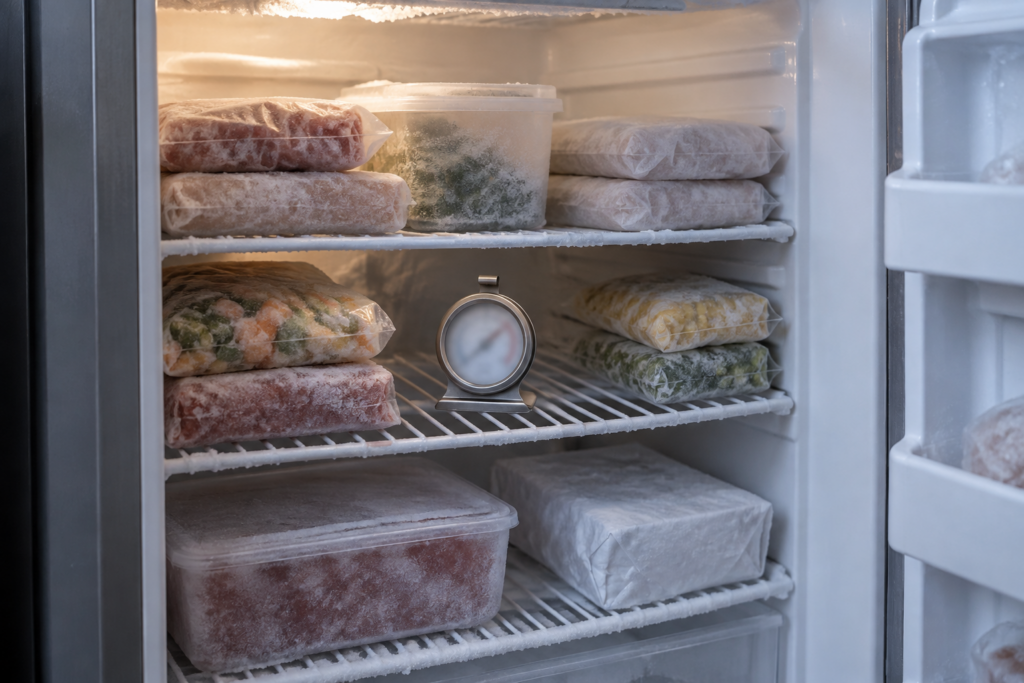
Both patterns explain the oddest part of a sensor fault: the freezer sounds normal. The compressor runs, the fan turns, and nothing clicks or hums unusually. The only evidence is the display and the food. Ice cream that is soft in one week and rock hard in the next is the classic hint, and so is a stack of freezer-burned packages in a cabinet that never alarmed.
Is It Safe to Keep Food in the Freezer With OP or SH Showing?
Yes for short-term use if you confirm the actual temperature with a separate thermometer, but never rely on the display alone. The site rates both codes as a maybe: OP may hold adequate temperature on the default schedule, and SH may cause freezer burn without being a food safety emergency, but neither is guaranteed without an independent reading.
- OP — if the cabinet stays below 0 degrees Fahrenheit, short-term use is acceptable while you arrange a repair, and above 10 degrees you should move the food at once.
- SH — a cabinet staying within about minus 5 to 5 degrees is acceptable short term, while one continuously below minus 15 means the board is over-driving the compressor.
- Either code — stop and call if the sensor code persists after the connector checks described below.
The Independent Thermometer Test
An inexpensive appliance thermometer turns a vague worry into a number. Put it in the middle of the cabinet, away from the vents, and read it after several hours without opening the door.
- Place the thermometer on a middle shelf and close the door.
- Read it after several hours and compare it with the set point, not with the display.
- Repeat the next day because a default schedule makes the result vary with room temperature and load.
- Write down the code exactly, OP or SH, and the temperatures you read.
The connector check the site describes involves removing the interior rear panel with the freezer unplugged, so it is a job to leave to a technician if you are not comfortable with it. Reseating a corroded plug is a reasonable repair for someone who is, and the site says a clean, firmly seated connector clears OP within two minutes of restoring power when that was the cause.
How These Codes Differ From HI, dF and PF
The other codes on the same freezer point elsewhere, and confusing them wastes time. Freezer HI is a temperature alarm: the cabinet really is warm, usually because of a failing door gasket, clogged condenser coils or a stopped evaporator fan. Freezer dF is a defrost failure that builds frost over weeks. PF is only a power failure notice. For the broader picture, our Kenmore freezer not freezing guide walks through those faults, and is it worth repairing a Kenmore freezer covers the money question.
A sensor fault is different because the freezer may be cooling perfectly well. What is broken is the information, not the refrigeration.
Getting It Repaired
A technician tests the sensor wiring and probe with a meter, checks the connector at the control board and replaces what is faulty, which is often the thermistor or a section of lead rather than the board. Keep the maintenance habits in Kenmore freezer maintenance in the meantime, and book through Kenmore freezer repair.
Three notes make the visit faster and the estimate firmer:
- The exact display — OP, SH or something else, and whether it appeared once or stays on.
- The thermometer readings — at least two, on different days, taken without opening the door.
- What the freezer sounds like — a compressor that runs constantly points the same way as SH, and one that seems to ignore the set point matches OP.
Tell us the model with those notes. Schedule a visit or contact us. The final price is confirmed after on-site diagnosis, with a written estimate before any work begins.