 Michael Turner
 Key Takeaways
- Kenmore dryer codes fall into three systems: airflow (AF, F30), motor and drive (F06), and control boards (F01, F70).
- AF and F30 are both restricted-airflow warnings, and a blocked exhaust path is a fire risk, not just a drying problem.
- F06 points at the drive motor's speed sensor specifically, not the motor windings or bearings — a freely turning drum with F06 is usually the sensor.
- A full power cycle of a full minute clears many F01 and F70 board communication faults; an immediate repeat means real hardware.
- L2 often traces upstream of the dryer to the outlet or breaker rather than to a part inside the appliance.
The Bottom Line
Write the exact code down, clear the lint trap and vent regardless of which code shows, and cycle power once before booking service. AF and F30 are airflow codes worth treating as a fire-risk warning, not just a performance complaint.
Kenmore dryer error codes have never had a single page on this site pulling them together, even though the individual code pages have existed for a while and the search volume behind "kenmore dryer error codes" is larger than almost any other unanswered question on this domain. Ten separate codes cover three different systems — airflow, the motor and drive, and the heating circuit — and knowing which system your code belongs to answers most of the "is this serious" question before a technician ever shows up.
| Code | What this site records | System |
|---|---|---|
| AF | Restricted airflow / vent blockage | Airflow |
| F30 | Restricted airflow detected | Airflow |
| F06 | Drive motor tachometer error | Motor and drive |
| F70 | No communication between main and UI boards | Control boards |
| F01 | Main electronic control board | Control boards |
| F22 | Exhaust thermistor (outlet) | Airflow / sensing |
| F26 | Door switch fault | Door |
| F28 | Moisture sensor strip fault | Sensing |
| L2 | Low or no L2 voltage on heater circuit | Heating |
| PF | Power failure — cycle interrupted | Power (record only) |
What Do AF and F30 Airflow Codes Mean?
Both point at restricted airflow, and both are worth taking seriously because a blocked exhaust path is the single most common cause of dryer fires, not just of poor drying performance. AF is the earlier warning — restricted but not fully blocked — and F30 is what follows once the restriction is severe enough that the drying cycle can no longer proceed safely.
- Clean the lint trap fully, not just the visible surface — pull the screen and check behind it too.
- Check the exhaust vent hood outside for lint buildup, bird nests or a flap that won't open.
- Inspect the full duct run if the code persists after clearing the trap and hood, since a long or crushed run restricts flow just as effectively.
- Do not run repeated cycles hoping the code clears itself — restricted airflow gets worse, not better, on its own.
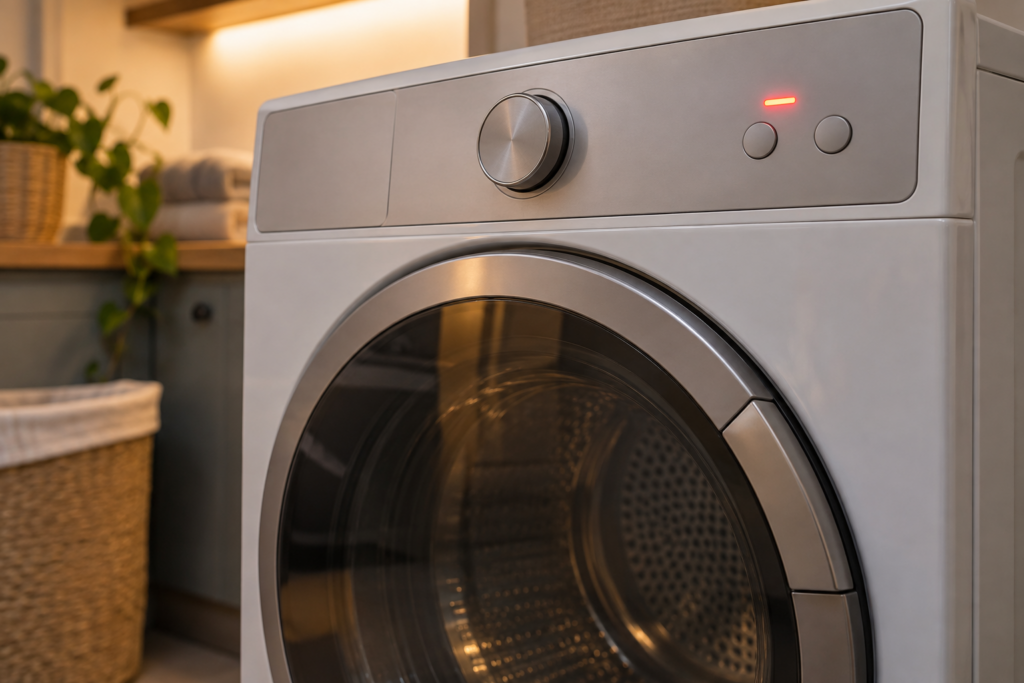
Is F06 a Motor Problem or a Control Problem?
It's specifically the drive motor's tachometer — a small sensor that reports the motor's actual speed back to the control board, not the motor's main windings or its bearings. When that feedback signal is lost or reads incorrectly, the board can't confirm the drum is spinning at the expected speed and stops the cycle rather than continuing on bad information. A drum that turns freely by hand with the dryer unplugged, combined with an F06 code, usually points at the tachometer sensor or its wiring rather than a seized motor.
What Does an F70 Communication Error Mean?
It means the main control board and the user interface board have stopped exchanging signals, and — like the F01 main board code — it's an electronics fault rather than a mechanical one. A full power cycle at the outlet or breaker, left off for a full minute, resolves a meaningful share of these by giving both boards a clean restart; a code that returns immediately afterward points at a genuine hardware or wiring fault between the two boards.
Door, Heating and Power Codes
F26, a door switch fault, is usually mechanical rather than electronic — a door that isn't latching fully, a switch plunger that's stuck, or a strike that has shifted slightly out of alignment. L2, low or no L2 voltage on the heater circuit, points upstream of the dryer itself: on an electric dryer this often traces back to the outlet, the breaker, or the household wiring supplying one leg of the 240-volt circuit rather than to a part inside the appliance. PF, a power failure record, clears on its own once acknowledged and simply confirms that power was interrupted mid-cycle.
- Check that the door latches fully and the strike plate is properly aligned if F26 appears.
- Have an electrician confirm both legs of the 240-volt circuit are present if L2 appears repeatedly.
- Treat PF as informational — restart the cycle and move on if it appears once.
- Note whether any of these codes appear alongside AF or F30, since a badly restricted vent can produce heat-related symptoms that look like a heater fault.
Is F28's Moisture Sensor Fault a Serious Problem?
Not usually — F28 reports that the moisture sensor strip, which tells the dryer's automatic cycle when clothes are actually dry, has stopped giving a reliable reading. It doesn't affect safety and it doesn't mean the heater or motor is at risk, but it does mean the automatic dry cycles can run too long or end too early until the sensor is addressed. A build-up of fabric softener residue on the sensor bars, which sit inside the drum near the door, is a common and easily fixed cause worth checking before assuming the sensor itself has failed.
- Wipe the metal sensor bars inside the drum with a cloth dampened with vinegar or a mild cleaner to remove residue buildup.
- Avoid dryer sheets directly on the sensor area going forward, since they're the most common source of the residue that causes this fault.
- Run a timed cycle instead of an automatic one as a temporary workaround while the sensor issue is diagnosed.
- Book a repair if cleaning doesn't resolve it, since a genuinely failed sensor strip is a straightforward part to replace.
What to Check Before You Book a Repair
A short list of checks either resolves the code outright or tells the technician exactly which system to bring parts for.
- Write down the exact code and whether it appeared once or repeats every cycle.
- Note what the dryer was doing when the code appeared — start of cycle, mid-cycle, or during the cool-down phase.
- Clear the lint trap and check the exhaust hood regardless of which code is showing, since restricted airflow can trigger codes outside the AF/F30 pair.
- Cycle power for a full minute before assuming a board-level code is permanent.
Our guide on Kenmore front load dryer lint and vent cleaning covers the full cleaning routine that prevents most of the airflow codes in this table from happening at all, and our Kenmore dryer repair or replace guide covers the decision once a repair is confirmed. If your dryer's noise, not its display, is the actual complaint, our Kenmore dryer motor replacement cost guide covers that separate symptom.
Booking the Repair
A tachometer sensor, a board-to-board communication fault and a restricted vent are three different repairs at three different price points, which is why writing the exact code down matters before calling. Our Kenmore dryer repair service covers the full airflow, drive and control system behind this table, and a diagnostic visit starts from $89. The final price is confirmed after the on-site diagnosis, with a written estimate before any work begins.
Tell us the exact code and how often it repeats when you book a visit or send us the details, and the technician arrives already knowing which system to check first.