 Michael Turner
 Key Takeaways
- A Kenmore washer drain pump replacement starts from $175 all in, with the part from $50 and the labor from $100.
- F21, F9E1 and LD are the drain codes, and the filter, hose and standpipe come before the pump and cost nothing.
- A pump that gets no power points at the control board drain relay, which is a higher-priced board repair.
- Running cycles with standing water in the drum can burn out the pump motor, so stop once a drain code shows.
- A new top-load Kenmore starts from $500 and a front-loader from $700, so a pump repair is well under the 50 percent line.
The Bottom Line
The drain pump is the most frequent Kenmore washer repair and one of the cheapest, from $175 all in. Clean the filter and check the hose first, and get a diagnostic before a part is ordered.
A Kenmore washer drain pump replacement cost starts from $175 all in, which is the figure this site gives for the single most frequent washer service call. It sits in the lower tier of washer repairs, and it is the part behind the three drain codes, F21, F9E1 and LD. What makes the number worth understanding is not the pump itself but everything that comes before it, because most drain codes are fixed for nothing.
| Step | What it is | What it costs |
|---|---|---|
| Clean the pump filter | Coin trap behind the lower front panel | No part, a few minutes |
| Straighten the hose, check the standpipe | Kinks, depth, standpipe height | No part |
| Diagnostic visit | Testing the pump circuit and relay | from $89 |
| Drain pump parts | The pump on its own | from $50 |
| Drain pump labor | Access, swap and a full test cycle | from $100 |
| Drain pump replaced, all in | Parts and labor together | from $175 |
| Control board, if the relay is at fault | The pump is fine but never gets power | from $220 |
How Much Does a Kenmore Washer Drain Pump Replacement Cost?
From $175 all in for the part and the labor, with the part itself starting from $50 and the labor from $100. The final price is confirmed after the technician completes the on-site diagnosis, and you receive a written estimate before any work begins. The starting figure assumes a washer where the pump is reachable and the part is in stock, and it moves with the platform as described below.
The reason the drain pump leads the repair list is that it works hard and is easy to starve. A pump that is forced to labor against a blockage runs hot, and the site warns that repeatedly running cycles with standing water in the drum can burn out the pump motor. In other words, the cheapest way to avoid this bill is to stop starting cycles once the washer has shown a drain code.
How Do You Know It Is the Pump and Not the Filter?
By doing the free checks first, because the filter is the most common cause and the pump is the second. On a front-loader showing F21 or F9E1, the coin trap behind the lower front panel packs with lint, coins and small garments, and the pump cannot move water past it. Only when the filter is clean, the hose is clear and the washer still will not drain does the pump come under suspicion.
- A clean filter and a clear hose with F21 returning on every attempt — the pump has failed or the board is not sending it power.
- A humming pump that moves no water — the impeller is blocked or broken, and the machine should be unplugged to protect the motor.
- A silent pump where a whir should be — either a seized motor or no signal from the board.
- A pump that runs for ten minutes with no change in water level — a stop sign on the top-load LD code.
The board version is the one that changes the price. If the pump receives no signal because the drain relay on the control board has failed, replacing the pump does nothing and the repair becomes a board job at the higher tier shown above. That is why the diagnostic comes before a part is ordered. The single-code pages for F21, F9E1 and LD list the order of checks.
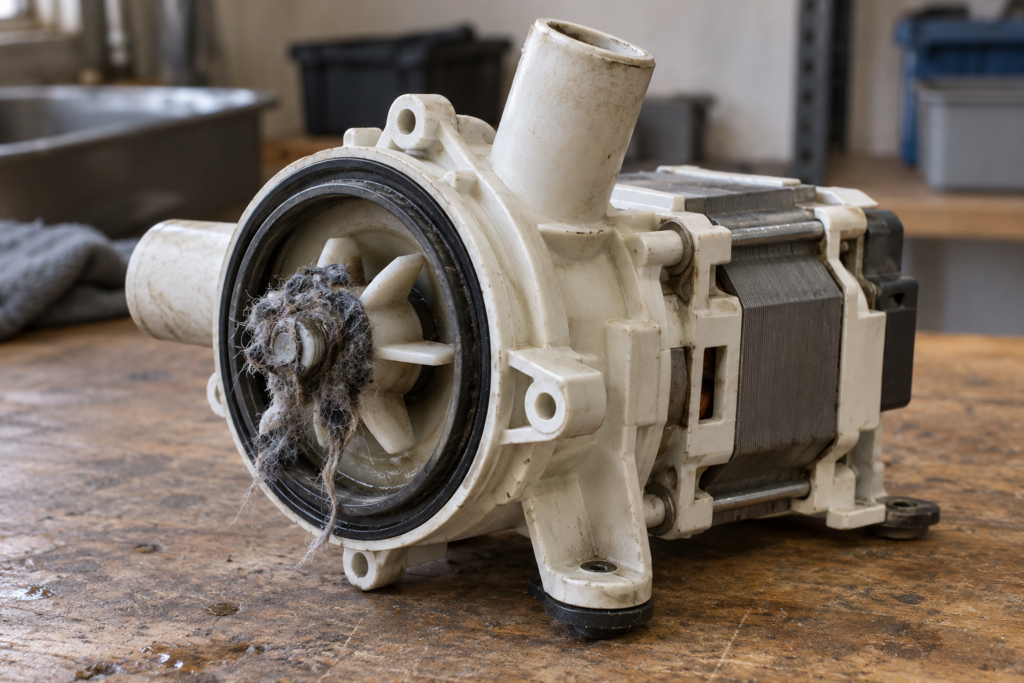
It also helps to know what the code does not tell you. F21, F9E1 and LD all say the drain took too long, which is a description of the symptom, not a diagnosis of the pump. The same code appears with a clogged filter, a kinked hose, an over-tall standpipe or a dead pump, and the first three cost nothing to fix. A quote that goes straight to a pump on the strength of the code alone skips the cheap possibilities.
The part that surprises people is how little of the bill is the pump. The part itself is among the cheaper components in a washer, and most of the starting price is the labor of getting to it, testing the circuit and proving the repair with a full drain cycle. That is also why two quotes for the same pump can differ: one includes the diagnosis and the test cycle, and the other may price only the part and an hour of labor.
What Makes the Price Move?
Three things: where the pump sits, who built the platform, and whether the part is still made. On many front-loaders the pump is behind the lower front access panel, but on some 110-series sub-models replacement needs partial drum removal, which adds labor. Top-loaders such as the Oasis can have no accessible pump filter at all, so the pump has to be reached by taking the cabinet apart.
- The platform — Whirlpool-platform pumps are widely stocked and sit at the low end of the range.
- The access — a pump behind a panel is a short job, and one behind the drum is a long one.
- The age of the washer — some Elite-specific assemblies have become harder to source since Sears stopped selling these machines.
- A second fault — a failed drain relay or a worn lid switch turns one repair into two.
Is a Drain Pump Worth Replacing on an Older Kenmore Washer?
Yes, for almost any age. This site puts drain pumps, inlet valves and lid locks in the lower tier of washer repairs, worth fixing on a washer of almost any age, while drive components and control boards sit higher. The numbers explain why: a new Kenmore top-load washer starts from $500 and a front-loader from $700, so a repair from $175 is far below the 50 percent threshold that usually decides these questions.
The exceptions are narrow. A pump replacement on a front-loader that also has a failing drum bearing is a different conversation, because the bearing repair is the expensive one and it makes the pump a side issue. Our guide on is it worth repairing a Kenmore washer covers that line, and Kenmore washer repair cost sets the pump beside every other washer part.
What to Do Before You Pay for a Pump
A short routine rules out the free causes and gives the technician better information, and none of it involves opening the cabinet.
- Unplug the washer and clean the filter. Place towels and a shallow pan under the lower access door, drain it slowly and clear every coin and lint ball.
- Check the drain hose. No bend tighter than about a 6 inch radius, and no more than 8 inches of hose inside the standpipe.
- Run a Drain and Spin cycle. If the water goes, the code clears by itself and no part was ever needed.
- Write down what you heard. Humming, silence or a rattle each point at a different part.
Kenmore suggests cleaning that filter every one to three months on a front-loader, which is the cheapest drain insurance there is. The wider code costs are in Kenmore washer error code repair cost.
Booking the Repair
Tell us the model number, the code and what the pump sounded like, and we can book the right visit through our Kenmore washer repair service. Schedule a visit or contact us with the code. The final price is confirmed after the on-site diagnosis, with a written estimate before any work begins.