 Michael Turner
Key Takeaways
- Level the washer with a bubble level front to back and side to side, then lock every foot with its nut.
- All four legs must touch the floor firmly, because a rocking washer turns a small imbalance into a stopped spin.
- An unlevel washer vibrates in spin and speeds drum bearing wear.
- A tub that travels more than about two inches when rocked points to worn suspension rods.
- Recheck after a week, because an unlocked foot creeps in use.
The Bottom Line
Leveling is a short job that protects the bearings and the spin. Level, lock the feet, and book service only if the washer still walks.
A washer that is a few degrees out of level still washes, so the problem is easy to ignore. It shows up later and elsewhere: a thump in the spin, a cabinet that creeps across the floor, a load that comes out wetter than it should. Of all the upkeep a Kenmore washer needs, a Kenmore washer leveling check is the cheapest, a short job that needs a bubble level and a wrench. This guide covers how to do it on both top-load and front-load machines, why the lock nuts matter, and what a washer that will not stay level is telling you. If the display shows UL, the code itself is explained on our washer UL page.
| Sign of a washer out of level | What is happening | What to do |
|---|---|---|
| Rocking when you push a top corner | One leg is not touching the floor | Lower that leg until it is firm |
| Thumping and the cabinet walking in spin | The tub is out of balance against the cabinet | Level, then lock every foot |
| Spin stops early, clothes come out wet | Repeated unbalance retries at lower speed | Redistribute the load, check the level |
| Growling that grows over months | Years of vibration wearing the bearings | Level now, and see the bearing guide |
| Lid or door closes unevenly | Cabinet is twisted off square | Level front to back and side to side |
How Do I Level a Kenmore Washer?
Place a bubble level on top of the machine, adjust the leveling feet until the bubble is centered in both directions, then lock each foot with its nut. The maintenance guide on this site gives exactly that sequence: a carpenter's level on the top surface, front to back and side to side, with the leveling feet adjusted at each corner.
- Switch off and unplug the washer, and pull it far enough from the wall that you can reach the back legs.
- Put the level on the top, first front to back, then side to side.
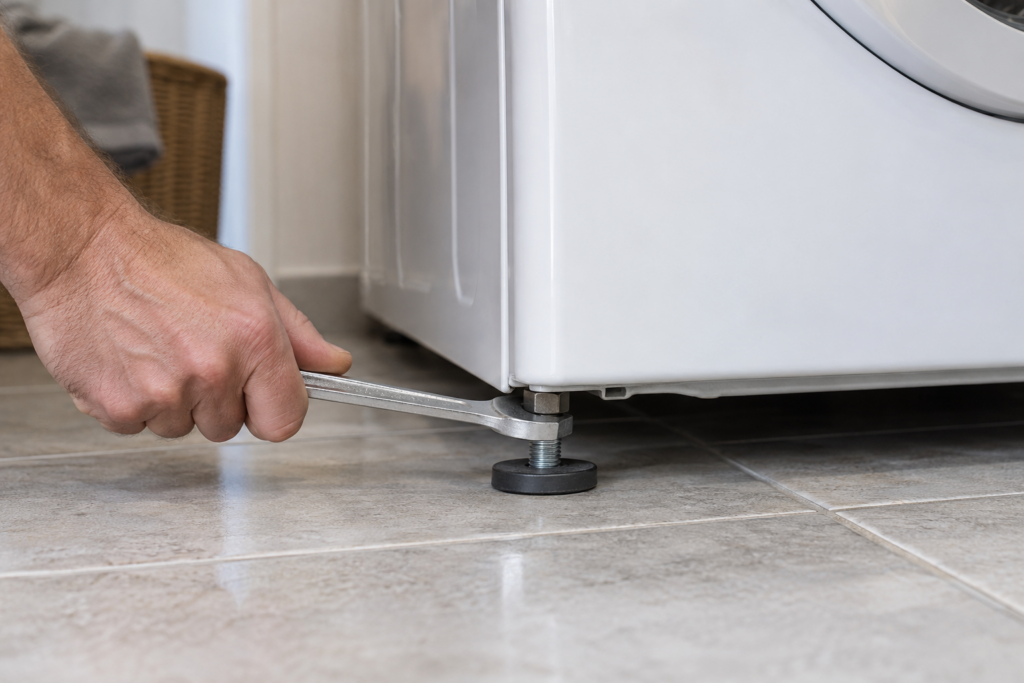
- Turn the feet by hand or with a wrench to raise or lower each corner. On top-loaders the front legs are threaded into the bottom corners of the cabinet.
- Rock the machine diagonally. If it moves, a leg is still off the floor, so adjust again.
- Tighten the locking nuts against the cabinet so the feet cannot creep.
- Run a spin cycle and watch for movement.
Four things are worth checking while the machine is out: the leg has no cracked foot, the floor is not sagging under it, the drain hose is not pinched behind it and the power cord is not trapped.
Why Does an Unlevel Washer Matter?
Because the tub spins fast against a cabinet that is not squarely supported, and the stress goes into the suspension and the bearings. Our washer maintenance guide says an unlevel washer vibrates excessively during spin, accelerating drum bearing wear, and can walk across the floor.
The effect on the spin is just as practical. The UL page explains that a washer that is not level rocks during spin and turns a small imbalance into a UL-triggering one, and that all four legs must contact the floor firmly. That is why the same load can spin fine one month and stop the next after a move or a floor change. Wrinkled, soaked laundry at the end of a cycle is often a level problem, not a motor problem.
- Bearings — the repair that follows years of vibration, covered by our HE2 Plus washer bearing repair cost guide.
- Suspension rods — worn rods let the tub travel too far, and a level machine does not cure them.
- Hoses and fittings — a washer that walks stretches its connections.
- Noise — the thump that sends people looking for a repair.
What if the Washer Will Not Stay Level?
Then the cause is usually the feet, the floor or the suspension, and each has a different fix. A foot whose locking nut was never tightened works loose in a few weeks of vibration, so tighten it first and recheck after a week. A soft or sloping floor is a separate problem that no adjustment fully solves, and a sloping floor that needs the feet fully extended leaves the machine unstable.
The UL page gives a test for the suspension. With the machine empty, grip the tub with both hands and rock it side to side. A tub with healthy rods moves little and returns smoothly to center, while one that travels more than about two inches easily, or clunks, points to worn rods.
- Feet loose again — tighten the locking nuts firmly and recheck.
- Floor flexes under the machine — a technician or installer can advise on a stable base.
- Tub travels too far — worn suspension, which the UL page says is a DIY-accessible job on the top-loaders it covers.
- Moves even when level and balanced — worth a diagnostic visit.
Top-Load or Front-Load: Does the Method Change?
The principle is the same, and the details differ a little. On the top-load machines our UL page describes, two front legs thread into the bottom corners of the cabinet, and you adjust them with the machine empty. A front-load washer has feet at each corner, and its heavier drum makes a firm, locked foot even more important.
- Top-load — check level front to back and side to side on the top panel, then test the tub travel.
- Front-load — check on the top and, if the door allows, across the door opening, and lock every foot.
- Either type — a second person helps to tilt the machine slightly while you turn a foot.
Whichever you own, remember that the machine is heavy and the floor under it matters as much as the feet.
A Simple Routine for a Steady Washer
Level the machine when it is installed, after any move and whenever it starts to walk. In between, a quick look is enough. Wipe up water around the base, check that the hoses are not stretched taut, and glance at the level when you clean the top.
Our washer UL code explained guide is the right page if the display has already stopped a spin, and the washer safety guide covers the hazards of a machine that vibrates hard. Loading habits matter too: spread items loosely, never wrap a long sheet around the agitator and avoid washing a single heavy item alone.
Booking a Visit
If the washer will not hold its level, walks even when balanced or growls in the spin, book a technician before the bearings pay for it. Tell us the model number, the symptom and whether the washer is top-load or front-load. The work belongs to our Kenmore washer repair service. Schedule a visit or contact us. The final price is confirmed after the on-site diagnosis, with a written estimate before any work begins.