 Michael Turner
 Key Takeaways
- E1 means the induction coil temperature sensor has failed and the zone is disabled, while E2 means the IGBT power module overheated.
- E2 clears itself after cooling, and a cooldown of at least 20 minutes plus lower power is the first response.
- If E2 returns within 30 minutes of moderate cooking, the module has degraded and the cooktop should not be used until serviced.
- Blocked ventilation, grease on the heat sink fins and long high-power sessions cause most E2 faults and cost nothing to fix.
- Repair is usually favored on a built-in cooktop, and induction parts are costly enough to apply the 50 percent rule carefully on older units.
The Bottom Line
Treat E2 as heat and grease first, and E1 as a sensor repair. Replace only when a degraded module or a second fault hits a cooktop near the end of its 10-to-15-year life.
An induction cooktop that stops one zone and shows E1 or E2 puts its owner at an awkward fork. Induction is the newest and priciest cooking technology in the Kenmore lineup, its repair parts are dearer than a gas igniter or an electric coil, and the cooktop sits in a countertop cutout that makes replacement a bigger job than the price tag suggests. The two codes, though, are very different faults, and one of them is often nothing more than heat and grease. This guide uses them to make the repair-or-replace call sensibly.
| Code | What the site says it reports | Can you keep cooking? | Usual route |
|---|---|---|---|
| E1 | Induction coil temperature sensor fault on the affected zone | No, that zone is disabled | Repair: sensor, connector or zone board |
| E2, clears after cooling | IGBT power module overheated, often from grease or airflow | Yes, at reduced power | Clean and adjust; no repair needed |
| E2, returns within 30 minutes | Degraded IGBT power module | No, until serviced | Repair, then weigh age |
What Do E1 and E2 Mean on a Kenmore Induction Cooktop?
E1 means the temperature sensor on the induction coil has failed, and E2 means the power module that drives the zone has overheated. The site describes both for Kenmore Elite induction cooktops. Our cooktop E1 page lists a failed NTC sensor bonded under the coil as the most common hardware cause, with a loose or corroded connector and a failed zone driver board behind it. Cooktop E2 points at the IGBT power module, the transistor stage that switches current to the coil, which trips on temperature.
The difference matters to the decision. E1 is a lost reading and the zone is disabled until it is restored. E2 is a thermal protection response, so the board clears it automatically once the module cools, and what you do next depends on how soon it comes back.
Can You Keep Cooking With E2 Showing?
Yes, at reduced power after a cool-down, as long as E2 does not return quickly. The site's guidance is to wait at least 20 minutes, then use the zone at a lower power level. If E2 comes back within 30 minutes of moderate cooking, at power level 5 or below, the module has degraded and the cooktop should not be used until it is serviced. Stop at once if there is a burning smell or visible discoloration on the glass above the zone.
- E2 after a long, high-power session — usually the duty cycle: the site says modules are rated for full power in short bursts, not extended continuous operation at maximum.
- E2 that returns progressively sooner — the classic sign of a failing module.
- A fan running at full speed — on models with a cooling fan, this accompanies E2 as the board tries to cool the module.
- Glass unusually hot over the zone — residual heat from the overheated module conducts up through the coil assembly.
The Free Fixes Before Any Decision
Most E2 episodes end here, which is why the repair-or-replace question should wait. The causes the site lists first are not parts at all: blocked ventilation beneath the cooktop, and sustained high-power cooking. Both are things you can change without a technician.
- Let it cool for at least 20 minutes and restart the zone at a lower power level.
- Check the cabinet below. The site cites at least 2 inches of clearance on all sides in a cutout installation, and nothing stored in the cabinet should block the bottom vents.
- Back off one or two power levels for long cooking, for instance from 9 to 7.
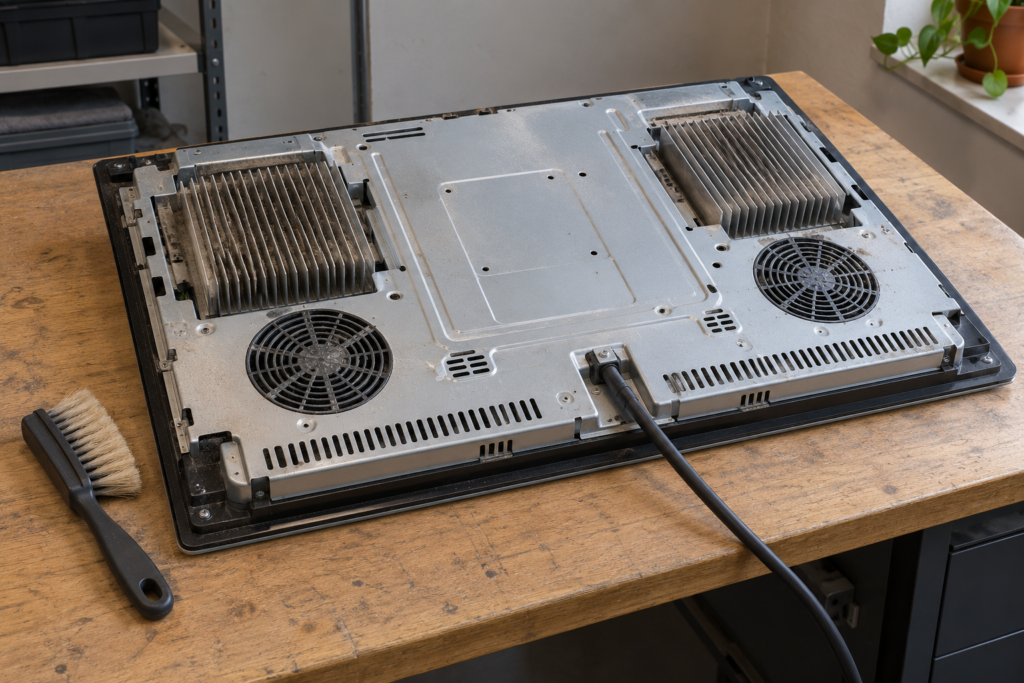
- Have the vents and heat sink fins cleaned. Grease mist settles there over years and is the most common cause of progressive E2 faults, so an annual clean extends the module's life.
The vent cleaning involves lifting the cooktop out of its cutout with the breaker off, which many owners will want a technician to do. The gain is large, because a cooktop that stops tripping after a cleaning has avoided a repair altogether.
What to Do When E1 Disables a Zone
E1 is the rarer and the more definite of the two. The affected zone shows E1 on its display, ignores touch input and does not even chime when a pan is placed on it, because the disabled zone never energizes its coil to look for cookware. The other zones usually carry on, so the cooktop stays partly useful while you arrange a repair. The site rates E1 as not safe to bypass, since the cooktop cannot detect overheating on that zone without its sensor.
- Try a 60-second power cycle once — a transient signal spike can clear, and a failed part will bring E1 straight back.
- Stop if E1 returns within seconds — repeated returns mean the sensor or its harness has physically failed.
- Look for heat damage at the connector — melted plastic, burned insulation or discolored terminals are a reason to switch the cooktop off at the breaker.
Use only the zones that work normally until the repair is done. The sensor is a small part, and a technician can tell whether the fault is the sensor, a corroded connector or the zone board behind it, which is the difference between a modest repair and a larger one.
Kenmore Induction Cooktop Repair or Replace: Where Does E2 Land?
Repair, in most cases, because the cooktop is built into a countertop and replacing it means more than buying a cooktop. Our Kenmore cooktop repair or replace guide explains that the built-in installation adds cutout, wiring and labor to any replacement, which tilts the numbers toward repair. It also warns that induction parts are the dearest in the cooktop range, so the 50 percent rule should be applied with care on units over about eight years old.
- E1 on a newer cooktop — a sensor or connector repair is the answer, and it is the cheapest route.
- E2 that cleaning cures — nothing to repair, and nothing to replace.
- E2 from a degraded module — repair if the cooktop is within its expected 10 to 15 years and nothing else is failing.
The technician's findings decide the rest. The site lists a discolored heat sink, dried thermal paste between module and sink, and out-of-specification resistance across the module's gate and emitter as the signs that the module itself is gone.
When Replacement Wins
Replacement wins when the induction cooktop is near the end of its realistic life and the repair is a module or board. The site gives induction 10 to 15 years of expected service, a shorter track record than gas, which lasts 15 to 20. A second zone failing, or a cracked glass surface at the same time, can also push a repair past half the cost of a new unit.
When you reach that point, see is it worth repairing a Kenmore cooktop and Kenmore cooktop repair cost for the wider numbers. Ask the technician for the component price in writing before you decide, since the site's own induction board figures vary between guides.
Booking the Repair
Our Kenmore cooktop repair service covers induction as well as gas, electric coil and smooth-top models, and a diagnostic visit confirms the fault and gives a written estimate before any work starts. Tell us the model, which zone, the code and how long after cooking it appeared. Schedule a visit or contact us. The final price is confirmed after on-site diagnosis, with a written estimate before any work begins.