 Michael Turner
 Key Takeaways
- F01 and F1 name the main or primary board, while F11 and F7 point at the motor control unit, which is a different module.
- A 60-second hard reset and a reseated harness are the free checks, and a burned connector means the board has been arcing.
- The 50 percent rule keeps a board repair inside the threshold on an HE top-loader under nine years old.
- Past the eighth year, or with other faults appearing, most owners stop at the board and weigh replacement.
- The Whirlpool 110-series platform has the strongest parts supply, though some Elite-specific assemblies are harder to find.
The Bottom Line
Reset and reseat first, then let age and other faults decide. Under about nine years with nothing else failing, repair the board; past ten with repeated repairs, weigh a new washer.
When a Kenmore washer shows a control board code, the question owners ask is whether the washer is finished. Usually it is not. A board is a single module in an otherwise sound machine, and the codes that name it are specific about which one has failed: the main board, the motor control unit, or the link between them. The decision is then about age and platform, not about the code.
| Code | Washer | Board involved | The one check you can do |
|---|---|---|---|
| F01 | Elite front-load | Main control board, EEPROM memory | Reseat the harness, 60-second hard reset |
| F11 | Elite front-load | Motor control unit (MCU) or central control unit (CCU) | Reseat the CCU-to-MCU harness |
| F1 | Oasis top-load | Primary control board | Reseat the connectors behind the console |
| F7 | Oasis top-load | Motor control unit, or the motor itself | Check the MCU-to-motor harness |
Kenmore Washer Control Board Repair vs Replacement: Where Is the Line?
The line is set by age and by what else is wrong, not by the board alone. This site's repair-or-replace guide for Kenmore washers applies a 50 percent rule: a repair is worth doing while its cost stays under half of a comparable new washer. For a control board on an HE top-loader under nine years old, that puts the repair inside the threshold, and a new top-load Kenmore starts from $500 before delivery and installation.
Age is the second input, and it works against the board in particular. This site's cost guide notes that a board fault past the eighth year is where most owners stop, because the board is one of the more expensive parts and the rest of the machine is by then aging too. That is a judgment, not a rule, and the useful question is whether the washer has other warning signs: a leaking door boot, a noisy bearing, repeated repairs in the last 18 months.
- Repair the board — the washer is under about eight or nine years old and nothing else is failing.
- Repair the board — the washer is the only unit in a stacked pair, so replacing it means replacing both.
- Weigh replacement — the washer is past ten years and the board is not the first problem.
- Weigh replacement — you have had several repairs in 18 months and a new fault has just arrived.
The general guide to this call is Kenmore washer repair or replace, and this page narrows it to the boards.
Is It the Board or Just a Loose Connector?
It can be either, and the connector comes first because it is the only part of the question you can answer for free. The site describes a loose or corroded harness connector as the one accessible check before committing to a board on F01, F11 and F1. An intermittent connection mimics a failure, and a firmly reseated plug occasionally clears the code for good.
- Unplug the washer for a full 60 seconds. A hard reset lets the board capacitors discharge, and a one-time power glitch often clears.
- Ask what came first. A code right after an outage or a storm has a fair chance of clearing, while one that has appeared on every cycle for days is probably permanent damage.
- Look for burn marks. Heat discoloration on a connector pin means a high-resistance joint that has been arcing, and the connector must not be reused.
- Reseat each connector until it clicks. Gently tug individual wires, because a broken conductor often looks fine but has slight play.
On the Oasis top-loader the board is reachable from the console without removing the lid or any inner panels, which is why its connector check is a simpler job than on a front-loader. Anything beyond a reseat is for a technician, and the single-code pages for F01, F11, F1 and F7 list the stop signs.
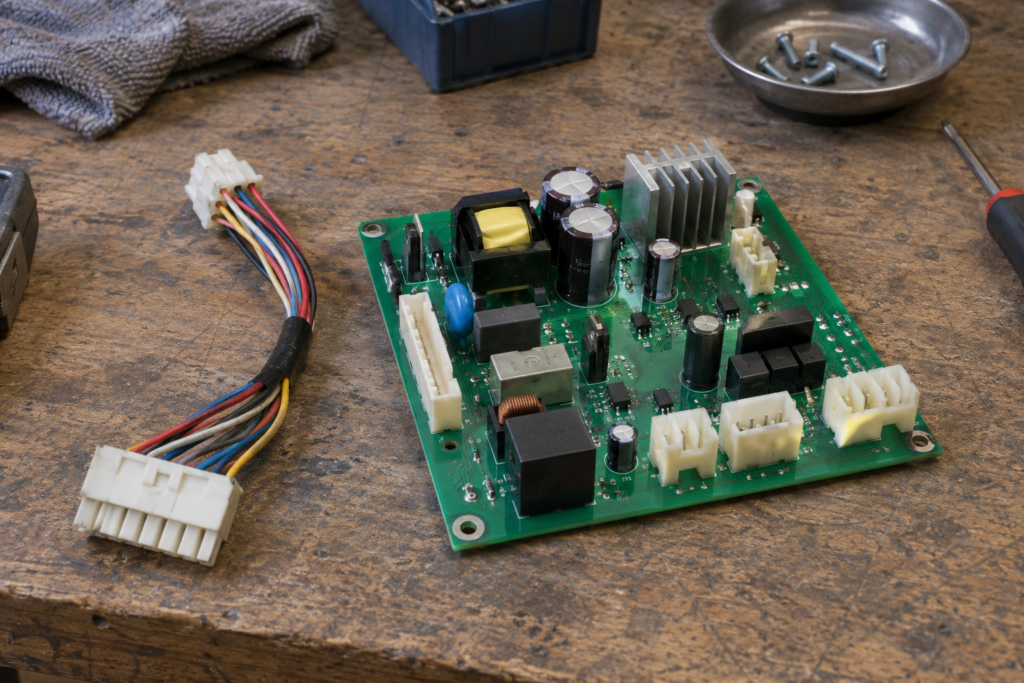
A word on surge protection, since it is the one preventive step in this guide. Both F01 and F1 are listed with a power surge as a cause, and the damage can be silent: the washer seems fine until the next cycle asks the board to read its memory. A surge protector at the outlet is inexpensive compared with a board, and it is worth fitting after any board repair so that the new part does not meet the same fate.
Why the Motor Control Unit Changes the Repair
F11 and F7 point at a different board from F01 and F1, and that changes what you are paying for. The motor control unit is the board that drives the wash motor, and the site names it as the most common hardware failure behind a persistent F11 on Elite front-loaders and a leading cause of F7 on the Oasis. A burned drive transistor is the typical story, and the clue is a burning smell from the lower rear of the cabinet during spin.
That matters for the repair-or-replace maths in two ways. First, the MCU is a smaller, more specific part than the main board, so it is not automatically the biggest line on the estimate. Second, the MCU can only be confirmed by substitution or bench testing when there is no visible damage, which is why a diagnostic comes before a part. A technician should rule out the harness and the motor itself before replacing a board that was never at fault.
- F11 on every spin — the MCU loses contact at the same motor load point.
- A drain pump that keeps running with the cycle halted — the central unit can no longer hand off control to the MCU.
- F7 with a hum but no rotation — a seized motor, not a board, is the alternative.
What a Technician Can and Cannot Tell You From the Code
A board code narrows the problem to a module, not to a single failed component, and the site is candid about the limits. An MCU with no visible damage may still be electrically dead and can only be confirmed by substitution or bench testing, which is why a good estimate names what was tested rather than what was assumed. Ask which board the technician believes has failed, how it was confirmed, and what happens to the price if the first board is not the cause.
- Ask what was tested — the harness, the motor and the board are three different checks.
- Ask about returns — electronic parts are often not returnable once installed.
- Ask about the next failure — a surge that killed one board can have weakened another.
Does the Platform Change the Answer?
Yes. The Whirlpool 110-series platform behind these codes is the most serviced Kenmore washer platform, with excellent parts availability and technicians who know it well. This site's cost guide notes that board prices diverge by builder, with Whirlpool boards at the low end and LG-platform boards higher, and that some Elite-specific assemblies have become harder to source since Sears stopped selling these machines. The model prefix on the rating plate tells you which you have, and it is worth asking about parts before you authorize work on an older machine.
The cost side of the decision is covered in Kenmore washer error code repair cost, and our is it worth repairing a Kenmore washer guide treats the whole machine. If you are ready to find out which board it is, our Kenmore washer repair service tests the circuit before any part is ordered. The final price is confirmed after the on-site diagnosis, with a written estimate before any work begins. Schedule a visit or send us the code and the model number.