 Michael Turner
Key Takeaways
- Recalls are announced by the manufacturer — LG, Frigidaire, Electrolux, BSH — with Sears named as the seller, which is why they are hard to find under the Kenmore name alone.
- No campaign covers every Kenmore of a type: each one is keyed to a model and a serial range from a single production run.
- The digits before the decimal point in your model number identify the manufacturer and rule most campaigns in or out immediately.
- A recall does not expire, and an unregistered appliance from the 1990s is still the unit the notice was written about.
- Recall remedies are free to the owner; installation and maintenance hazards, which cause far more incidents, are never covered by one.
The Bottom Line
Write down the model and serial number in full, note the manufacturer prefix, and check against the published serial ranges rather than the brand name. If a unit is scorching, smoking or shocking anyone, switch it off at the breaker first and check afterwards.
People search for a Kenmore microwave recall, a Kenmore range recall or a Kenmore refrigerator recall and come away confused, because the campaigns are not listed under Kenmore in the way they expect. Recalls are announced by whoever built the appliance — LG, Frigidaire, Electrolux, BSH — with Sears named alongside as the seller. The badge on the door is not what the campaign is keyed to. Your model and serial number are.
| Year | Appliance | Hazard | Announced with |
|---|---|---|---|
| 2020 | Kenmore Elite over-the-range microwave | Burn hazard at the glass door | CPSC |
| 2016 | Kenmore wall oven | Thermal switch fire hazard | CPSC and Electrolux |
| 2015 | Kenmore Elite dishwasher | Power cord fire hazard | CPSC and BSH Home Appliances |
| 2015 | Kenmore electric range | Shock hazard from internal wiring | CPSC |
| 2012 | Kenmore Elite gas dryer | Fire hazard | CPSC, LG Electronics and Sears |
| 2009 | Kenmore washer | Drain pump fire hazard | CPSC and Frigidaire |
| 2009 | Kenmore Elite smoothtop electric range | Fire hazard | CPSC and Frigidaire (Electrolux) |
Why the Manufacturer's Name Is on the Notice
Sears commissioned its appliances rather than building them. Whirlpool, LG, Frigidaire, Electrolux and others produced the machines and Sears applied the Kenmore badge and its own model number. When a defect is found, the firm that manufactured the unit conducts the recall, which is why the announcements carry their name and not only Kenmore's.
That has a practical consequence. A recall never covers every Kenmore of a given type — it covers the production run that came out of one factory, identified by model and serial number. The three digits before the decimal point in your model number tell you which manufacturer's world you are in, and that alone rules most campaigns in or out before you read a single serial range.
What These Campaigns Were Actually About
The list on this site runs from a dishwasher door latch fire recall in 1996 through to a microwave burn hazard in 2020, and the pattern across them is worth noticing. Almost every one concerns heat, fire or shock, and almost none concerns the parts that fail in ordinary use.
- The 2020 microwave campaign concerned over-the-range units and a burn hazard at the glass door. Full details, including model numbers and the owner action required, are on our page for the Kenmore Elite microwave burn recall.
- The 2009 range campaign covered smoothtop electric ranges and a fire hazard, announced with Frigidaire and Electrolux — see the Kenmore Elite smoothtop range recall.
- The 2009 washer campaign concerned the drain pump and a fire risk, announced with Frigidaire under CPSC recall number 09-292 and covering roughly 35,000 units — see the Kenmore washer drain pump recall.
- Older campaigns still matter. A recall does not expire. A wall oven or a chest freezer from the 1990s that nobody ever registered is still the unit the notice was written about.
The other thing the list shows is how little the Kenmore name itself predicts. Two campaigns in the same year, 2009, covered a washer built by Frigidaire and a range built by Frigidaire; the 2012 dryer campaign came from LG; the 2015 dishwasher campaign came from BSH. Same badge on four appliances, four different sets of engineering decisions behind them. An owner who assumes the brand behaves as one manufacturer will check the wrong campaign and conclude, wrongly, that their unit is clear.
Checking Your Own Unit in Ten Minutes
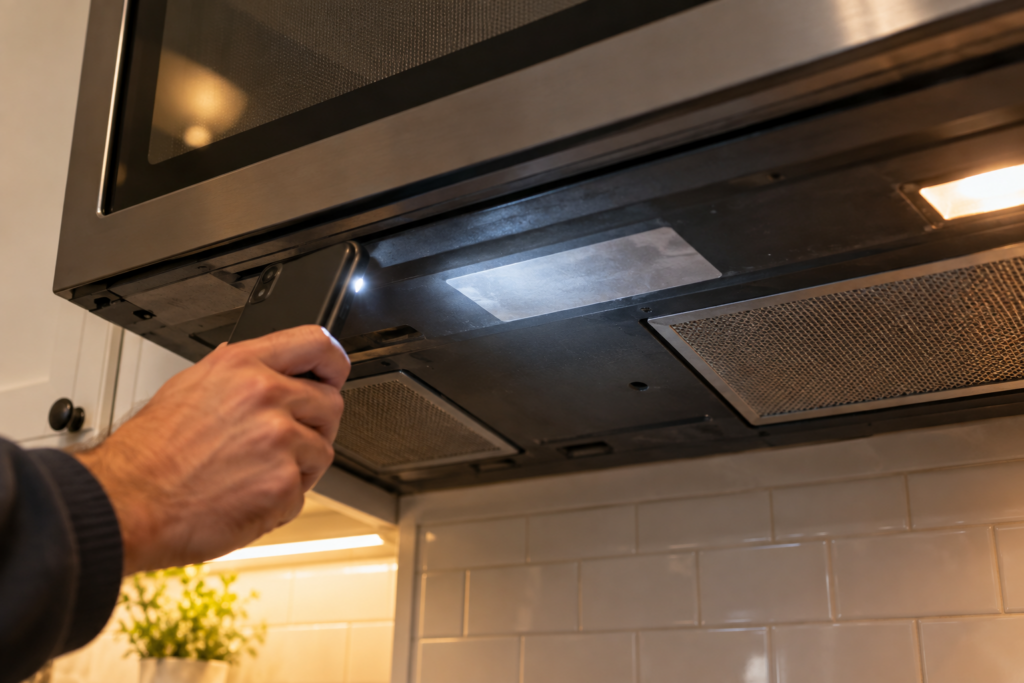
- Find the rating plate. On a microwave it is on the cabinet, often visible only from underneath; on a range, behind the storage drawer or on the door frame; on laundry, under the lid or inside the door opening.
- Write down model and serial in full. A serial number alone will not resolve a campaign, and neither will a model number alone.
- Note the prefix. The digits before the decimal point identify the manufacturer and tell you which campaigns could possibly apply.
- Compare against the published serial ranges, not against the appliance name. Two units with identical model numbers can fall on opposite sides of a range.
- Follow the remedy the notice gives. Recall remedies are free to the owner, and the notice says whether that means a free repair, a replacement part or stopping use.
The Hazards That Were Never Recalled
Recall campaigns cover manufacturing defects. They do not cover the risks that come from installation and maintenance, and those account for far more incidents. While you have the flashlight out, check the things no notice will ever tell you about: whether a free-standing range has its anti-tip bracket engaged, whether the dryer duct is rigid metal rather than plastic, whether the refrigerator's condenser is clear, and whether any appliance is running on an extension cord.
Those four checks take a few minutes each and none of them needs a tool. They also cover the failure modes that put appliances in the incident statistics year after year, long after every recalled unit has been repaired or scrapped. A recall is a one-time event tied to a batch; a blocked dryer duct or a range that can tip forward is a condition that gets worse quietly for as long as nobody looks.
Our guide to Kenmore range safety covers the range side of that list in detail, and the safety notice archive on this site collects the standing warnings alongside the recall campaigns.
If Your Unit Is Affected
A recall remedy comes from the manufacturer and costs the owner nothing, so that route is always the one to take first. Where we can help is with everything the notice does not cover: confirming what you actually own from the model prefix, and dealing with a unit that is out of scope but still showing the symptom that prompted the campaign.
Our Kenmore range repair service covers the cooking side, and a service visit starts from $85. The final price is confirmed after the on-site diagnosis, with a written estimate before any work begins. If an appliance is smoking, scorching, or giving anyone a shock, switch it off at the breaker and book a visit rather than waiting to see whether it happens again.