 Michael Turner
Key Takeaways
- The three digits before the decimal point in a Kenmore model number identify the manufacturer — 110 Whirlpool, 795 and 796 LG, 106 and 253 Frigidaire, 665 Whirlpool dishwashers.
- Owner booklets are brand-neutral; service literature, fault code tables and component locations are not, and they differ completely between platforms.
- Most Kenmore parts were never Kenmore parts, so availability is usually better than owners expect — search by the full model number, not by the appliance name.
- Warranty and coverage questions need the model and the serial number together; either one alone is rarely enough.
- Photographing every rating plate in the house takes one session and removes the hardest step from every future repair.
The Bottom Line
Read the whole model number off the rating plate, decimal point included, and identify the manufacturer from the prefix before you search for anything. Every manual, part number and fault code you need follows from that one piece of information.
Looking for a Kenmore refrigerator repair manual is where most Kenmore ownership problems start, because searching the word Kenmore returns documentation for half a dozen different machines. Sears never manufactured appliances. It commissioned them from Whirlpool, LG, Frigidaire and others, and the three digits at the front of your model number — everything before the decimal point — are the only reliable way to find paperwork that describes the machine actually standing in your kitchen.
| Model prefix | Built by | What that means when you look things up |
|---|---|---|
| 110 | Whirlpool | Laundry platform; parts common and the platform well documented |
| 106 | Frigidaire / Electrolux | Refrigeration; widely stocked parts, straightforward service literature |
| 253 | Frigidaire / Electrolux | Refrigeration; same family of documentation as 106 |
| 795 | LG | Refrigeration; the Er-prefixed fault codes belong to this platform |
| 796 | LG | Laundry; direct-drive, parts through LG channels |
| 665 | Whirlpool | Dishwashers; common parts and a long service life |
Where the Number Is, and Which Part of It Counts
The model number lives on a rating plate, not on the front of the appliance. On a refrigerator it is usually on the inside wall of the fresh food compartment, often low on the left. On a range it is behind the storage drawer or on the frame under the door. On a dishwasher it is on the tag along the inner edge of the door frame. On laundry it is under the lid, inside the door opening, or on the back panel.
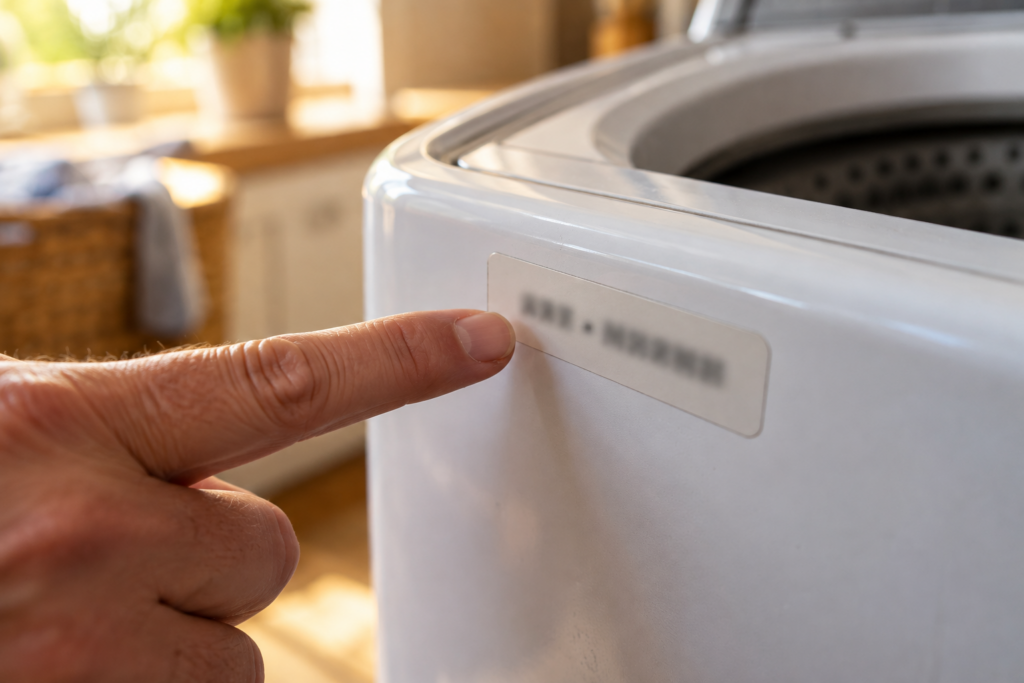
What you want is the whole string, decimal point included. The digits after the point identify the specific model within its maker's range; the digits before it identify the maker. People routinely copy only the second half into a search box and then wonder why nothing matches. Photograph the plate with your phone while you are down there — you will need it again, and the label on a twenty-year-old appliance does not get easier to read.
Why a Generic Kenmore Manual Misleads You
The use-and-care booklet that came with the appliance is written for the owner and is genuinely brand-neutral: loading, settings, cleaning. The service literature is not. Diagnostic sequences, component locations, resistance values and fault code tables all belong to the manufacturer, and they differ completely between platforms.
The clearest example is the fault vocabulary. An LG-built Kenmore refrigerator announces a failed freezer fan as an Er code. A Frigidaire-built one does not use that convention at all. Even a code that looks universal can differ: this site's entry for PF, power failure detected notes the 106-series refrigerators specifically, and a reader who assumed it applied to every Kenmore would be applying it to machines that never produce it.
So the rule is simple. Find the prefix, decide which manufacturer's world you are in, and only then look for a procedure. Our guide on what the model prefix tells you about repair goes further into what the mapping means for the repair-or-replace decision.
Parts, Part Numbers and Warranty Lookups
The same principle governs parts. Most components in a Kenmore were never Kenmore components — they are Whirlpool, LG or Frigidaire parts carrying a Sears part number on the box. That is good news for availability, and it is why a Kenmore of a given age is usually easier to source parts for than owners expect.
- Search by the full model number, not by the appliance name. A parts catalog keyed to the model will give you an exploded diagram; a search for the appliance name will give you guesswork.
- Cross-reference before you buy. The same physical part often appears under both a Sears number and the manufacturer's own, at different prices.
- Check the serial number for the build date. Mid-life platform changes mean two units with the same model number can take different parts.
- For any warranty question, have model and serial together. One without the other is rarely enough to establish coverage.
- Ask whether the specific part is still made before authorizing work on an older unit. Trim and cosmetic pieces disappear long before mechanical ones.
Build the File Once and Keep It
The five minutes this takes are worth more than any single repair, because you only ever do it once per appliance.
- Photograph every rating plate in the house. One session, one folder on your phone.
- Write the prefix beside each photo. Whirlpool, LG or Frigidaire — that is the word that makes every later search work.
- Save the use-and-care guide as a file, not as a booklet in a kitchen drawer that will be thrown out.
- Note the install date. Age drives every repair-or-replace decision you will ever make about that unit.
- Keep receipts with the file. Proof of purchase is what a warranty claim actually turns on.
Owners who do this stop having the conversation that begins with a technician asking for a model number and ending with someone lying on the kitchen floor with a flashlight.
When the Paperwork Runs Out
Documentation only takes you so far. Sealed-system work, control board diagnosis and anything behind the evaporator panel need instruments rather than instructions, and a service manual will tell you that itself. Our Kenmore refrigerator repair service covers that side, and preventive maintenance handles the routine work — condenser coils, door seals, drain lines — that keeps a well-documented appliance out of the repair queue in the first place.
A service visit starts from $85. The final price is confirmed after the on-site diagnosis, and you get a written estimate before any work begins. Have the model number to hand when you book a visit: with the prefix known in advance, the right parts travel with the technician instead of being ordered afterward.